

Smoke of Words
“Sweet smoke of rhetoric! He reputes me a cannon;
and the bullet, that’s he: I shoot thee at the swain.“
Shakespeare, Love’s Labour’s Lost, 3.1.66.
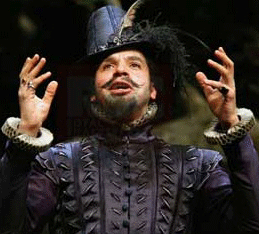
Joe Dixon as Don Adriano de Armado
The following list originally began as a small collection of words I liked the sound of and noted down for future use. Gradually the collection grow into a rhetorical word reference library, greatly influenced by the works of Shakespeare.
There was a colourful use of language during the seventeenth century, and many words used as standard English are today thought vulgar. If you read on please do not be offended.
This content is for information only and should not be considered complete or accurate, or perceived as expert or authoritative.
References to Shakespeare are marked as Shake., play title as follows. Ado = Much Ado about Nothing. All-W = All’s Well that Ends Well. Ant-Cleo = Antony and Cleopatra. As-Y = As You Like It. C-Errs = The Comedy of Errors. Cori = Coriolanus. Cym = Cymbeline. Ham = Hamlet. 1H4 = The First Part of King Henry the Fourth. 2H4 = The Second Part of King Henry the Fourth. H4 = King Henry the Fourth. H5 = King Henry the Fifth. 1H6 = The First Part of King Henry the Sixth. 2H6 = The Second Part of King Henry the Sixth. 3H6 = The Third Part of King Henry the Sixth. KJ = King John. KLr = King Lear. LLL = Love’s Labour’s Lost. Macb = Macbeth. Merc-V = The Merchant of Venice. Midsum = A Midsummer Night’s Dream. M-Wiv = The Merry Wives of Windsor. Meas-M = Measure for Measure. Othe = Othello. P-Pilg = The Passionate Pilgrim. R2 = King Richard the Second. R3 = King Richard the Third. Rape-L = The Rape of Lucrece. Rom-J = Romeo and Juliet. Shrew = The Taming of the Shrew. Temp = The Tempest. TGoV = The Two Gentlemen of Verona. T-C = Troilus and Cressida. Tit-A = Titus Andronicus. Tw-N = Twelfth Night. Wint-T = Winters Tale.
abodement, foreboding, omen, Shake., 3H6.4.7.13.
afar-off, remote, indirectly. Shake., M-Wiv.1.1.125, Wint-T.2.1.103.
after-eye, to look after, keep an eye on. Shake., Cym.1.3.20 “left To after-eye him”.
all-a’mort, a Gallicism, in the French a la mort ‘to death’, to mean sick to death, dejected, out of heart. Shake., T-Shr.4.3.36.
arts-vanishing, so skillfully done that the art has been concealed.
balmy-breath, persuasive ‘sweet-talk’, intimate so as to smell the breath. Shake., Othe.5.2.16 “balmy breath, that dost almost persuade”.
bang pitcher, drunkard, from pitch lined drinking vessels.
beard, the cut of. Once a custom to distinguish the profession and class by the cut of the beard, the cut adopted being known as the stiletto or spade, it is interesting to note that the clown’s-beard was left, uncut. Shake., H5.3.6.80 “a beard of the General’s cut.”
bed-fellow, one who shares the same of, bed-pess’er, a lazy fellow, one who does not get up early to work. Shake., 1H4.2.4.268. Also bed-swerver, one unfaithful in marriage. Shake., Wint.T.2.1.113; bed-vow, a love promise, as in a marriage vow, Shake., Sonnets 152.3; bed-work, work so easy as it could be accomplished without leaving bed, Shake., T-C.1.3.208.
belly cheer, good food.
belly ruffian, penis.
be-rime, to celebrate in rime (rhyme). Shake., Rom-J.2.4.44. Incantation, ‘riming rats’, Shake., As-Y.3.2.187.
bescreen’d, concealed. Shake., Rom-J.2.2.52 “bescreen’d in night.”
beslubber, smear with. Shake., 1H4.2.4.344. “beslubber our garments.”
best-mov’ing, most persuasive, Shake., LLL.2.1.29.
best-tempered, of the truest ‘metal’. Shake., 2H4.1.1.126 “best temper’d courage….For from his metal was his party steel’d”.
blackjack, a pitch lined leather beer jug, or jack. Jacked, treated with pitch to make waterproof.
blackberry, of little worth, common. Shake., 1H4.2.4.269 “as plenty as blackberries.” Shake., T-C.5.4.13 “is not proved worth a blackberry.”
blade, a roisterer or gallant.
blessing witch, a witch practicing beneficent magic.
blow upon, betray or discredit.
boot catcher, person employed to remove and clean boots.
bottom-room, a place or space prearranged to be taken, from the old practice of paying annual pewage, or rent for a church pew.
brabb’ler, a senseless arguer, Shake., T-C.5.1.106 “he will spend his mouth, and promise, like Brabbler the hound”. Shake., KJ.5.2.164. brabble, argue dispute with little reason, Shake., Tw-N.5.1.67 “In private brabble did we apprehend him.” Shake., Tit-A.2.1.64 “This petty (pretty, first folio) brabble will undo us all!”.
bratchet, a little brat, endearing.
breathing-time, daytime. Shake., Ham.5.2.181 “breathing time of day”. Breathing-while, a short time. Shake., R3.1.3.60.
breath upon, often blow upon, to inform on.
brewis, bread soaked in salt-beef stock.
bricked, smartly dressed.
bring a waste, get out of here.
bumpsy, drunk, from bumping into people.
care a piss, care not at all.
catch fart, a servant.
cater-cousin’s, related through affection or familiarity rather than blood, as would eat out of each-other pockets. Shake., Merc-V.2.2.136.
chavy, child or youth.
choice-drawn, chosen with great care. Shake., H5.3.Prol.24.
cleft the root, to hit the mark with notable consequence, as to split the wooden peg that attached the target to the butt with the arrow, in allusion to the heart. Shake., TGoV.5.4.111. “How oft hast thou with perjury cleft the root?”, same sense as ‘cleaving the pin’, LLL.4.1.150.
cloak’bag, silly talk, or simply a ‘fool’, from the time of the court fool, when he could be carried off in his motley cloak if he became too tedious. In the 17th Century there are many references to cloakbags of green motley which were coarse, cheap and common, but some too were made from a finer material. Shake., 1H4.2.4.501 “that stuffed cloak-bag of guts”, and derived from the parti-coloured coat of the ‘fools natural’, Shakespeare’s Motley (1952) by Leslie Hotson.
close as oak, as closely grained as oak, Shake, Othe.3.3.237 “could give out such a seeming, To seel her father’s eyes up, close as oak”.
close stool, a commode.
cock brain, (ed), foolish person.
cockscomb, a silly upstart, derived from the headdress of a fool, a fashion as old as the 14th Century, it often covered the head entirely and fell down over the shoulders, decorated to imitate a cocks’ comb.
come cut and long tail, to maintain quality whether good or bad, originally applied to dogs and horses. Shake, M-Wiv.3.4.48 “that I will, come cut or long-tail”.
cribb’ed, confined. Shake., Macb.3.4.27 “I am cabin’d, cribb’d, confin’d, bound in”. Crib, enclosed bed.
cupboard-love, secret affection, thought to have originated from the relationships of domestics, when need required to hide close affections was essential.
cup-shotten, intoxicated by alcohol, cup means to ply with drink. Shake., Ant-Cleo.2.7.102 “Fill till the cup be hid”, shotten, to render worthless, as a herring shed or ‘shot’ it’s roe, from Shake, 1H4.2.4.142 “then am I a shotten herring”.
curtain-lecture, lengthy council which one does not wish to heed, but is forced to hear, from the complaints a wife may issue to her husband when their curtains are drawn around their bed.
dancing water, washing in natural water, in Medieval times it was believed that washing in the morning May dew of the heath enriched health, “the reason given being that the dew had in it all the ‘nature’ of the spring herbs and grasses, and therefore it must be wonderfully strengthening”, Elizabeth M. Wright’s Rustic Speech and folk-lore (1914).
deep-mouth’d, intense profound talk.
dis’mal-dream’ing, persistent disheartened dreams, Shake., P-Pilgr.13.8. dismal, threatening ill-boding. Shake, 3H6.2.6.58 “dismal threat’ning sound, And his ill-boding tongue”.
door-particulars, private affairs, domestic concerns. Shake., K-Lr.5.1.35 “these domestic door particulars”, in modern editions the text reads these domestic particular broils.
duddery, a clothier’s booth, from dudds (clothes). Lag-duds, unwashed clothing.
fancy-free, free from the power of love. Shake., Midsum.2.1.168 “In maiden meditation, fancy-free”, fancy-monger, one who deals in love such as a ‘match-maker’, Shake., As-Y.3.2.384, fancy-sick, love sick, Midsum.3.2.97.
field’ed, ready for, or engaged in conflict, from the field of battle. Shake., Cori.1.4.16.
field-bed, to sleep out in an open field. Shake., Rom-J.2.1.40.
fine’bait’ed, subtly alluring. Shake., M-Wiv.2.1.99.
five and five, to divide or share an equal in common tribulation, so hungry that you would share half an eaten rat, from old use, when the besieged found themselves sharing rats to eat, or those on a ship, in absence of any other food, “of five and five to a rat in every mess”, Thomas Nashe Lenten Stuffe (1599).
five-fing’er-tied, tied very securely. Shake., T-C.5.2.182.
fool-begg’ed, to foolishly beg the wardship of, from petition to the Court of Wards for custody of (a minor, an heiress, or an idiot), as feudal superior or as having an interest in the matter, such as to take charge of any fortune or property, established by Henry VIII and suppressed under Charles II. Shake., C-Errs.2.1.41 “This fool-begg’d patience in thee.”
forspoken, bewitched.
fresh’water marina, one who sails through life inexperienced, or unwilling to take risks for the sake of a simple life, from a sailor who worked on inland waterways rather than face the dangers of the sea.
fuller the moon, a future of full richness.
gaudy-night, night of rejoicing. Shake., Ant.3.11.13.
glim flashy, showing anger.
groundling, a low class, from theatre goer who could only afford to stand in the open yard. Shake,. Ham.3.2.12 “the groundlings, who, for the most part, are capable of nothing but inexplicable dumb-shows and noise”, also see stinkard.
gull, deception, fool. Shake, Tw-N.2.3.146 “gull him into a nayword”, 5.1.220 “an ass-head and a coxcomb and a knave,-a thin faced knave, a gull!”, 5.1.366 “most notorious geck and gull”. H5.3.6.69 “a gull, a fool, a rogue“, R3.1.3.334 “simple gulls”, Othe.5.2.197 “O, gull! O, dolt! As ignorant as dirt!”. gulled, tricked into, Shake, H5.2.2.123 “hath gull’d thee thus”, a difficult course hard to depart from, a worn road full of ruts. In Thomas Dekker’s The Gull’s Hornbook, a “gull” is a fashionable or pretentious person easily duped by the streetwise denizens of London’s theatres, taverns, and eating houses. The Gull’s Hornbook serves as a satirical guide and primer on how to behave and survive the streets.
hang an arse, wait a while, for much of the 17th Century arse was used in standard English and did not become a vulgarity until after the 1660s.
heartsease, twenty shilling piece.
heavy-arsed, lazy.
hollow ware, pottery, table ware.
idle-while, an ineffective or worthless use of time.
importance, a wife.
infantry, children.
intelligencer, spy.
itch, got the itch, the sexual urge. Itch-buttocks, play at, sexual intercourse.
jugbitten, tipsey from drinking alcohol.
kissing-comfit, a sweetmeat perfumed for sweetening the breath. Shake., M-Wiv.5.5.22.
loose-bagg’age, a harlot or loose woman in the late 17th Century, later becoming milder in use.
marg’in-minstrel, or reading-writer, generally a reader of books who habitually scribbles annotation in it’s margin, known as marginalia, thought to be by some as willful vandalism of an authors work and by others as intellectual insight for subsequent readers, giving a second-hand book greater value containing the knowledge of one author and the wisdom of another.
moor-ditch melancholy, somber and moody, from Moor-ditch as part of the great moat of London 1211-1213, cleaned and widened 1595 which was filthy at the time. Taylor in his Pennylesse Pilgrimage 1618 “Walking thus downe the street, (my body being tyred with trauell, and my mind attyred with moody, muddy, Moor-ditch melancholly”. Shake., 1H4.1.2.86 “or the melancholy of Moor-ditch?”
muggle, term of endearment, ‘sweetheart’. “Vntill I see my muggle againe” Thomas Middleton (1608) Your Five Gallants. William Gouge, a Puritan clergyman, in his domestic conduct treatise Of Domesticall Duties (1622) warned husbands against using crude or unbecoming terms for their wives, including ‘muggle’.
peradventure, perhaps.
pert and coppet, impudent, saucy, sassy.
plunket, colour of light green (see sadd colour).
popinjay, colour of bluish green (see sadd colour).
puke, colour of dirty brown (see sadd colour).
ragg’ed-hour, the worst time/s. Shake., 2H4.1.1.162. “The ragged’st hour that time and spite dare bring…”.
rats’ castle, slum district, usually associated with underworld citadels, Rats’ Castle being a notorious block of London, the likes of which Dickens himself toured in the 1850s, and noted that they were dangerous places of dirty conditions occupied by, chiefly young, notorious thieves.
rat’s colour, colour of dull grey (see sadd colour).
rigging, clothes, rig-out.
rude mechanicals, a manual labourer, originally an artisans apprentice, a play going public of bawdy manners.
rumpscuttle, tomboy.
sadd colour, sadd carried the meaning of seriousness and were subdued colours of ordinary everyday clothing, with names such as, ash, blushing maid (rose colour), de Boys from du bois (a wood colour), dead Spaniard (pale greyish-tan), deer colour, French green (a very pale grey-green), ginger lyne, goose-turd (yellowish-green), Gridolin from gris de lin (flax blossom), Isabella (light buff), Lincoln green (forest green), lustie-gallant (light red), milk and water (bluish-white), orange, philly mort from feuille morte also known as ‘dead leaf’ (a dark grey-brown), plunket (light blue), puke (dirty-brown), popinjay (blue-green), purple, rat’s colour (dull grey), russet (reddish-brown), rust, sheep’s colour (natural), sangyn (blood-red), stammel (red), straw (light yellow), tawney (light yellowish-tan), watchet (deep-blue), whey (pale whitish-blue). There were many other names used of which the colour has not been ascertained.
scrimmage, rough tussle.
scryer, crystal ball gazer, fortune-teller.
settle board, settle, a wooden bench with a back that doubled as a container.
settle bed, as settle board, but opened out into a bed containing the mattress.
sheep’s colour, the natural colour of cloth before dye applied (see sadd colour).
smile and be a villain, literally meaning two-faced, appearing one thing and seeming another. Shake., Ham.1.5.112/114 “O, villain, villain, smiling, damned villain!-….That one may smile, and smile, and be a villain”, although villain was not always intended to describe qualities that were all bad, and were used in good humour and applied to a faithful bondsman/serf/servant/slave who would humour the master “having so good a mean”, C-Errs.1.2.19 “A trusty villain”, or affection as in, Wint-T.1.2.163 “sweet villain!”, and Tw-N.2.5.16, T-C.3.2.33 “the prettiest villain”.
smoke, of words, mere talk.
sparrow, any small bird, or person.
speak in print, to speak very precisely, exactly to the letter. “All this I speak in print” Shake., TGoV.2.2.181. Burton in his Anatomy of Melancholy, writes “He must speak in print, walke in print, eat and drink in print, and that which is all in all, he must be mad in print.”
squiny, to look peeringly at, as to draw attention. Shake., KLr.4.6.155 “I remember thine eyes well enough. Dost thou squiny at me?”
standing water, still, not in flow. Shake., Tw-N.1.5.169 “’tis with him in standing water, between boy and man”. Temp.2.1.248 “I am standing water”.
start’ing-hole, a refuge or place to hide. Shake., 1H4.2.4.290 “what starting-hole, canst thou now find out, to hide thee from this open and apparent shame?”
trencher, a plate or platter (usually wooden). Shake., Temp2.2.192. “Nor scrape trencher, nor wash dish”, Rom-J.1.5.2. “he shift a trencher! he scrape a trencher!”, trenchering, trenchers collectively, trencher-fed, fed or kept each to a master, trencher-friend, one who feeds off another as a parasite, Tim-Ath.3.6.102, trencher-knight, same as -friend and, or one who frequents the table of another, or a serving-man at table (waiter), LLL.5.2.500, trencher-man, a hearty eater, Ado.1.1.51. “and he hath holp to eat it: he is a very valiant trencher-man, he hath an excellent stomach.”
truckle bed, a low bed on wheels pushed under another bed. Many family members slept in the same bed chamber, or even the same bed, in the old days.
under’stand’ers, an audience that stands around the stage of a theatre, because they are under the actors and able to understand the spoken word the better.
watchet, colour of greenish blue (see sadd colour).